
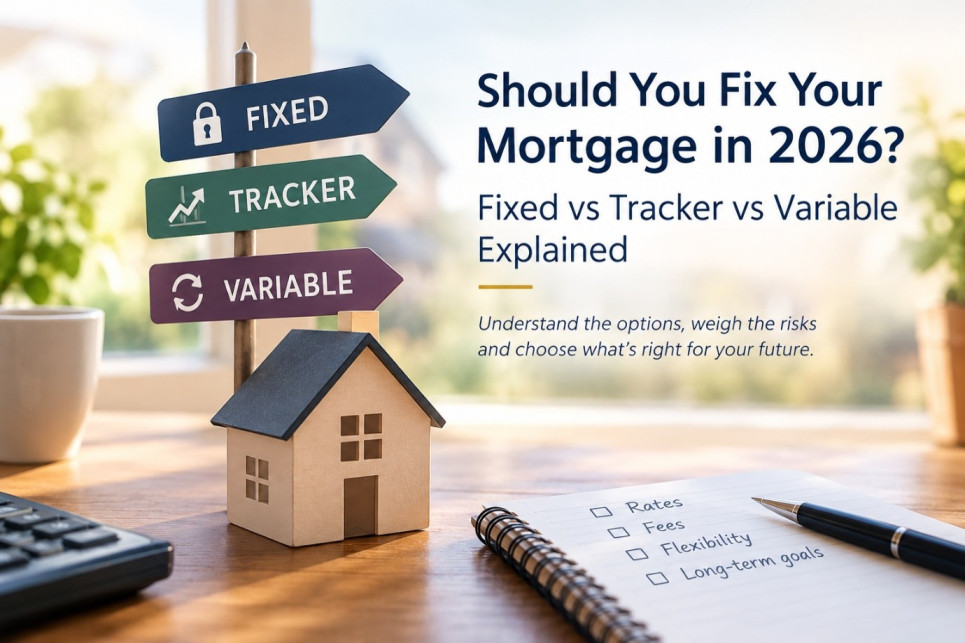
Should You Fix Your Mortgage in 2026? Fixed vs Tracker vs Variable Explained
Thinking about your next mortgage deal? The biggest question may not be “What is the lowest rate?” but “Which type of mortgage gives me the right balance of certainty, flexibility and risk?”
For many UK homeowners, choosing a mortgage used to feel relatively straightforward: find a competitive fixed rate, lock it in and get on with life.
But the mortgage market is not quite that simple anymore.
With Bank of England Rate currently at 3.75%, borrowers are once again weighing up whether to fix their mortgage, take a tracker, or consider another type of variable-rate deal.
So, should you fix your mortgage in 2026, or could a tracker mortgage be worth considering?
The answer depends less on what everyone else is doing and more on your own circumstances.
Fixed vs Tracker vs Variable: What's the Difference?
Before deciding which option is right for you, it helps to understand how each one works.
1. Fixed-rate mortgage
With a fixed-rate mortgage, your interest rate stays the same for an agreed period — commonly two, three or five years.
This gives you something many homeowners value highly: certainty.
If your rate is fixed, your mortgage payment won't increase simply because Bank of England Rate rises during your fixed period.
The trade-off is that you generally won't benefit from falling interest rates during the fixed period either.
You may also face an Early Repayment Charge (ERC) if you want to leave the mortgage before the end of the fixed period.
2. Tracker mortgage
A tracker mortgage follows the Bank of England Bank of England Rate, plus a specified margin.
For example, a mortgage might be priced at:
Bank of England Rate + 0.75%
If Bank of England Rate is 3.75%, the mortgage rate would be 4.50%.
If Bank of England Rate rises, your mortgage rate can rise.
If Bank of England Rate falls, your mortgage rate can fall.
That makes trackers potentially attractive when rates are falling — but it also means you need to be comfortable with your payments changing.
It’s also worth checking the fees and flexibility attached to a tracker. Some lenders offer tracker rates with no product fee and no early repayment charge, while others may charge a product fee and/or apply an Early Repayment Charge if you repay or switch during the deal period. Always check the specific product terms, as the fee structure and ERC are separate considerations. It is also worth noting that the ERC for Tracker mortgages are typically less than that of the Fixed mortgage.
3. Variable-rate mortgage
Fixed or Tracker Mortgage products, if not remortgaged after the specified period, will move on the the Standard Variable Rate of the lender. With a variable-rate mortgage, the interest rate can change during your mortgage term. This means your monthly mortgage payment can also go up or down.
Unlike a fixed-rate mortgage, your rate isn't guaranteed to stay the same for a set period.
The way the rate changes depends on the type of variable-rate mortgage and the lender. Some variable rates are linked to the lender's Standard Variable Rate (SVR), while others may be based on a discount from the SVR.
For example, if your mortgage has a rate that is 1% below the lender's SVR, your rate will change if the lender changes its SVR.
This is different from a tracker mortgage, where the rate is normally linked directly to an external rate such as BoE Rate.
The main thing to remember is that with a variable-rate mortgage, your rate and monthly payments can change, so you need to be comfortable with the possibility of paying more if rates increase.
Fixed vs Tracker: What's the Real Trade-Off?
| Fixed | Tracker | |
|---|---|---|
| Payment certainty | High | Lower |
| Benefits if rates fall | No, during the fix | Yes |
| Impact if rates rise | Generally protected during fix | Payments can increase |
| Budgeting | Easier | Requires more flexibility |
| Early repayment charges | Often apply | Depends on product |
| Main attraction | Certainty | Potential flexibility / benefit from falling rates |
Why Are Borrowers Looking More Closely at Trackers?
The mortgage market has changed significantly over the last few years.
After the sharp increase in interest rates, borrowers became accustomed to higher fixed mortgage rates. As rates subsequently moved lower, the question changed from:
“How much will mortgage rates rise?”
to:
“How much further could they fall — and when?”
That creates a dilemma.
If you fix your mortgage and rates subsequently fall, you may be locked into the higher rate until your deal ends.
If you choose a tracker and rates rise instead, your monthly mortgage payment could increase.
In other words:
A fixed mortgage buys certainty.
A tracker gives you exposure to changing rates.
Neither is automatically “better”.
What Happens If Interest Rates Rise?
This is one of the most important questions to ask before choosing a tracker.
Imagine you have a £250,000 repayment mortgage and your mortgage rate increases by 0.50 percentage points.
The effect on your monthly payment will depend on factors such as:
- Your outstanding mortgage balance
- Remaining mortgage term
- Current interest rate
- Whether the mortgage is repayment or interest-only
The key point is that even a relatively small rate movement can make a noticeable difference to household finances.
So before choosing a tracker, ask yourself:
Could I comfortably afford my mortgage if the rate increased by another 1%?
If the answer is no, the potential saving from choosing a tracker may not justify the additional risk.
What If Interest Rates Fall?
This is where trackers can become attractive.
If your mortgage rate is linked to Bank of England Rate and Bank of England Rate falls, your mortgage rate may fall as well, depending on the terms of your product.
That could reduce your monthly payments.
A fixed-rate borrower, however, normally won't immediately benefit from falling rates during their fixed period.
But there is an important caveat:
Nobody can guarantee the direction or timing of future interest-rate movements.
The Bank of England's job is to keep inflation low and stable, and its Monetary Policy Committee meets regularly to decide Bank of England Rate.
So choosing a tracker because you are certain rates will fall is effectively making a prediction about the future.
That is a risk worth understanding.
Should You Fix Your Mortgage in 2026?
A fixed rate may make sense if:
You value payment certainty
If knowing exactly what your mortgage payment will be each month helps you manage your household finances, a fixed rate can provide valuable certainty.
Your budget is relatively tight
If a significant increase in your mortgage payment would put pressure on your finances, protecting yourself from rate increases may be more important than trying to benefit from potential rate reductions.
You don't want to speculate on interest rates
You don't need to predict what Bank of England Rate will do.
You can simply choose the certainty of knowing your mortgage rate for the agreed period.
Could a Tracker Mortgage Make Sense?
A tracker may be worth considering if:
You can tolerate payment changes
You have sufficient disposable income or savings to cope if your mortgage payment increases.
You value flexibility
Some variable-rate products can offer different repayment or exit features, although the exact terms vary between products.
You believe the potential benefits justify the risk
The important point is not whether rates will fall.
It's whether you can comfortably manage the mortgage if they don't.
Don't Forget the 2-Year vs 5-Year Fixed Decision
The choice isn't always simply:
Fixed vs tracker.
If you decide to fix, you may also need to consider:
2 years vs 3 years vs 5 years.
A shorter fix could give you the opportunity to review your mortgage sooner.
A longer fix could provide greater payment certainty for a longer period.
But a longer fixed period can also mean:
- Longer exposure to the agreed rate
- Potentially higher ERCs
- Less flexibility if your circumstances change
- Less ability to benefit from better rates in the future
Again, there is no universally correct answer.
Don't Choose a Mortgage Based on the Rate Alone
When comparing mortgage deals, look beyond the headline percentage.
1. The product fee
A mortgage with a lower interest rate may come with a higher arrangement fee.
2. Early Repayment Charges
Could you face a significant charge if you move, refinance or repay early?
3. Overpayment options
Can you make additional payments without penalties?
4. Portability
If you move home, can the mortgage potentially be transferred to the new property?
5. Your Loan-to-Value
Your LTV can have a significant impact on the mortgage products and rates available to you.
6. Your future plans
Are you likely to move house, change jobs, have children, retire or make a large financial change during the mortgage period?
The right mortgage today needs to make sense for your wider financial circumstances — not just your circumstances on the day you apply.
The Biggest Mortgage Mistake? Trying to Predict the Market
It's tempting to think:
“Rates are going down, so I'll wait.”
Or:
“Rates might rise, so I need to fix immediately.”
But predicting interest rates is difficult.
Even professional economists and financial markets can change their expectations as inflation, economic growth and global events develop.
Instead of asking:
“What will rates do next?”
consider asking:
“What happens to my finances if rates move in either direction?”
That is a much more useful question.
So, Fixed or Tracker?
There is no one-size-fits-all answer.
A fixed mortgage may suit someone who prioritises certainty and predictable payments.
A tracker may suit someone who is comfortable with rate fluctuations and the associated risk.
A variable-rate mortgage could suit some borrowers depending on the specific product, pricing and flexibility.
The right choice depends on your:
- Income
- Existing commitments
- Deposit/equity
- Loan-to-value
- Mortgage balance
- Remaining term
- Future plans
- Risk tolerance
- Ability to absorb higher payments
The key takeaway?
Don't choose a mortgage simply because it has the lowest rate today.
Choose a mortgage that makes sense for your circumstances and the risks you are prepared to take.
Thinking About Your Next Mortgage?
The mortgage market can be difficult to navigate — particularly when there are several different products, rates, fees and terms to compare.
At Pinnacle Financial Solutions, we can help you understand the options available and consider the wider costs, risks and features of different mortgage products.
Whether you're a first-time buyer, home mover or looking to remortgage, getting advice can help you make a more informed decision.
Your mortgage is likely to be one of the biggest financial commitments you make. It's worth looking beyond the headline rate.
Speak to Pinnacle Financial Solutions today to discuss your mortgage options.
Disclaimer: This article is provided for general information only and does not constitute mortgage, financial or legal advice. Mortgage eligibility, lending criteria, interest rates and product availability vary between lenders. Always seek professional advice before making financial decisions.
Your home may be repossessed if you do not keep up repayments on your mortgage.